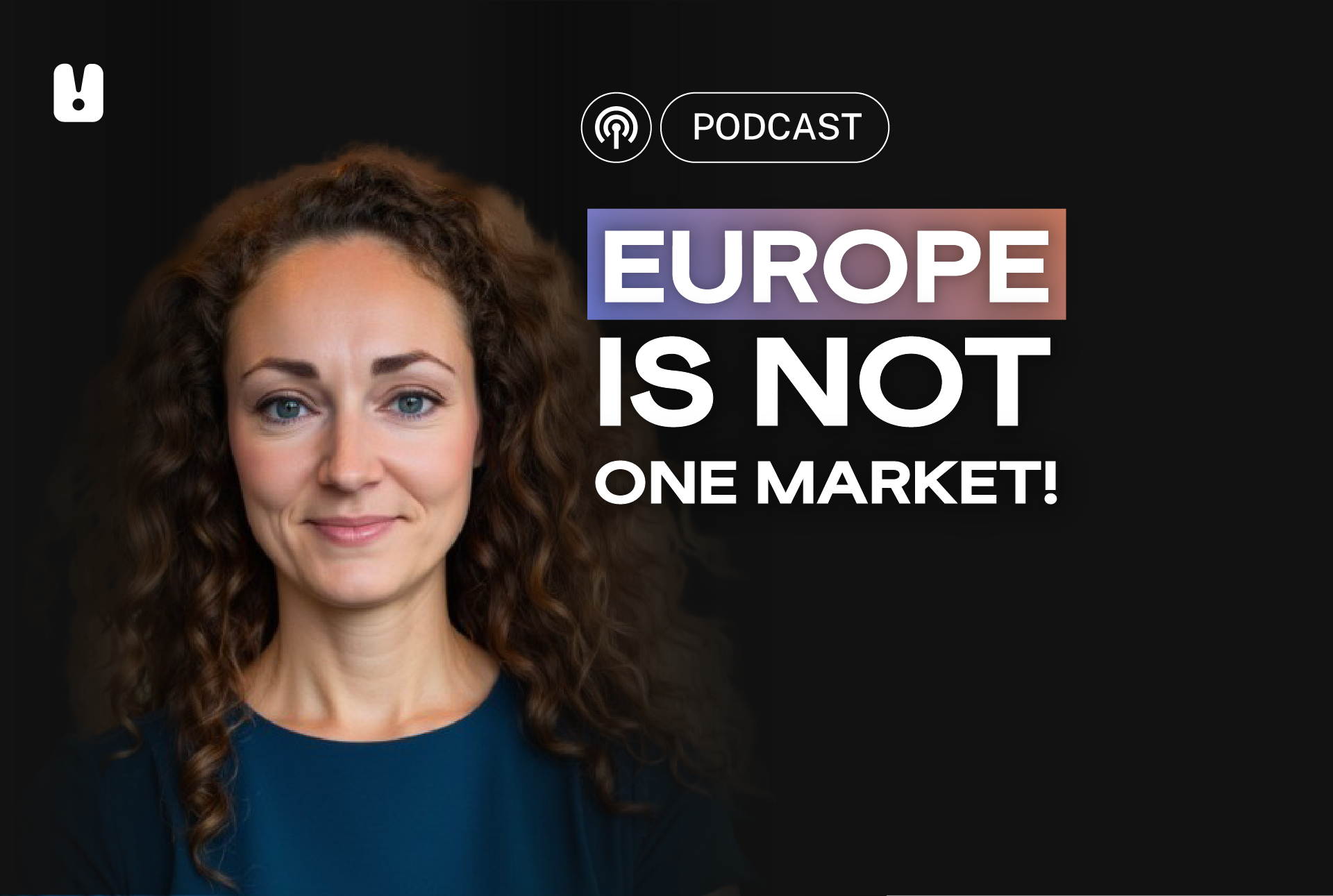
Europe IS NOT One Market


US tech companies fail at European expansion by treating it as one market when each country has distinct buyer processes, compliance requirements, local competitors, and pricing needs. Anastasia Albert presents the Three C's Framework (Customer, Competition, Company) for successful market-by-market GTM strategy across Europe.
If you're a US company looking at Europe as your next expansion market, stop right there. That "Europe is one market" assumption? It's costing you deals, burning your budget, and setting your sales team up to miss targets.
In the latest episode of B2B Outbound, hosts Chris and James sat down with Anastasia Albert, founder of B2B Practitioners - a go-to-market consultancy that bridges the gap between strategy and execution. With over 12 years navigating the European tech landscape, Anastasia delivers the reality check every US founder needs to hear before expanding overseas.
The Europe Myth That's Killing Your Expansion
Here's the brutal truth: "Europe is not one market," Anastasia states bluntly. "There are significant differences when it comes to how people buy software. Be it language, be it compliance, be it buying decision process."
Think about that. You wouldn't use the same playbook for California and Texas. So why treat Germany, France, and the UK as interchangeable?
The Three C's Framework
B2B Practitioners uses a framework called the Three C's – Customer, Competition, and Company. Here's how it breaks down for European markets:
Customer
Your ICP isn't universal. German mid-market companies might be stuck on legacy systems, making them slow adopters. Meanwhile, Nordic enterprises could be early tech adopters hungry for innovation.
Anastasia breaks down what really matters: "We look at industry, company size in terms of employees and revenue, tech stack – which can be very different per market."
Take ERP systems. The US has its players. Germany has completely different ones. That means different integrations, different pain points, different messaging.
But here's where it gets really interesting: the buying process itself changes by market.
"In Germany, there's a lot of emphasis on privacy and security," Anastasia explains. "You might have a data privacy officer coming into the buying decision process that will say, 'No, we cannot purchase the solution because of A, B, C.'"
That's a stakeholder you didn't even know existed. And they've got veto power.
Competition
Your US competitors might not even operate in Europe. But there's a whole ecosystem of local players who own market share, have established relationships, and speak the language – literally and figuratively.
"You have a lot of local players in Italy, France, Germany that might be completely different to the US," Anastasia notes. "You want to position yourself against those competitors in your messaging."
This means localized proof points: regional case studies, local certifications, testimonials from companies your prospects actually recognize.
Company
Your pricing model might need adjustments. Payment terms? Longer in Europe. VAT mechanics? Welcome to reverse charge for B2B cross-border services.
"You sometimes have different add-ons," Anastasia points out. "In the e-commerce space, you have very different marketplaces per country. So the add-ons will be different."
Even something as simple as payment providers varies by market. Get this wrong, and you're adding friction to deals that should close.
The GDPR Panic
Let's address the elephant in the room: Can you even do outbound in Europe?
"It's a bit of a gray area," Anastasia admits. "You can do it if there is a reason to do it. If you have a reason to contact the person, it's actually a little bit easier to do it via phone than in the written way."
Here's what's really happening: US legal teams don't understand GDPR, so they blanket-ban all outbound. But legitimate business interest exists. If you've done your research, identified the right personas, and have a genuine reason to reach out, you're fine.
The real issue? Everyone's spamming with AI-generated "personalization" that isn't personal at all.
"I'm amazed how spammy it still is and how you can literally see that they haven't done their research at all on your company," Anastasia says.
The Language Question
Should you localize? It depends.
"If you're in the IT space targeting CIOs and IT leaders, they're very proficient in English because they work in English," Anastasia explains. "But if you're going after typical mid-market Germany HR people, that can be quite tricky to approach them in English."
But here's the kicker: It's not just about translating words. "US is all about selling the big fish in the ocean. In Europe, customers are more skeptical about big promises. You might want to adapt your language and build trust first."
That's not a translation issue. That's a fundamental cultural shift in how you sell.
The Playbook That's Breaking Down
Anastasia sees the struggle firsthand: "Some targets are being hit by many B2B tech companies. You have a hard time executing on the old playbooks that used to work quite well. To some extent, you have to come up with new ideas, new playbooks."
What's working now? A return to fundamentals:
- Brand building over performance marketing: Budgets are shifting toward PR, events, and offline relationship building
- Small, intimate gatherings: Roundtables and dinners with target personas
- Unified go-to-market: Sales, marketing, customer success, and product working as one function
"Go to market is being centralized under one function," Anastasia observes. "We're not looking at marketing bringing in MQLs and then sales converting them. We're looking at our go-to-market as a factory."
The One Piece of Advice Before You Expand
If you're a US company eyeing European expansion, here's what Anastasia wants you to hear:
"Don't assume Europe is one market. Don't launch kind of an EU with US messaging or English-only assets. Don't under-invest in proof. Really invest in local case studies, maybe certifications. Don't ignore security, legal, privacy points. Take a bit more time to look into that."
Key Takeaways
- Europe isn't a single market – buying processes, stakeholders, and regulations differ significantly by country
- The Three C's framework (Customer, Competition, Company) must be applied market by market
- GDPR doesn't ban outbound, but your legal team's fear of it might be holding you back
- Localization isn't just translation – it's adapting your entire selling approach
- Old digital marketing playbooks are breaking down; brand building and offline events are making a comeback
The Bottom Line
European expansion isn't impossible. But it requires more than translating your website and hiring a couple of sales reps in London.
You need to understand each market's buying psychology, competitive landscape, and regulatory environment. You need local proof points, adapted messaging, and patience to build trust in cultures that value substance over hype.
Get it right, and Europe represents massive growth opportunity. Get it wrong, and you'll burn through budget faster than you can say "GDPR compliance."


Continue reading
.png)


Subscribe to Punch! newsletter
A monthly dose of Sales Intelligence, delivered straight to your inbox