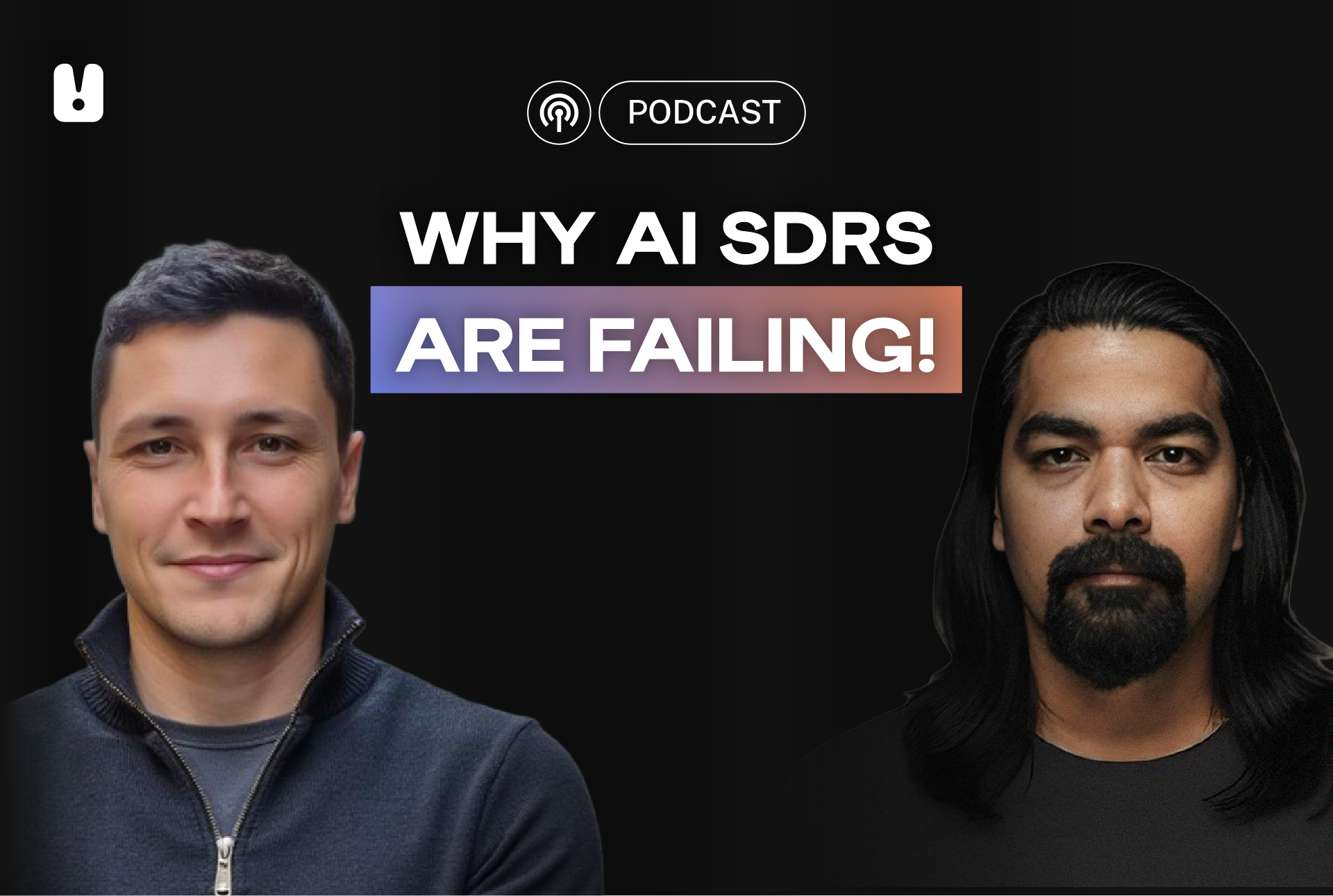
Can Agentic AI Actually Run Your GTM Engine?


In the latest episode of B2B Outbound, host Chris is joined by co-host Ben and guest Samir, who leads go-to-market engineering, artificial intelligence, and automation work at Punch!. The conversation covers agentic AI, signal-based selling, and why GTM engineering still needs a human in the loop, whatever the platform demos promise.
Why “Set It and Forget It” AI Doesn't Work
Every platform on the market claims to have solved outbound. Ben isn't convinced. He describes most of them as looking fantastic on the surface, great websites, great social proof, while underneath there's just a stack of agents with not much human coordination behind them. The result is a flood of generic messages built from the same handful of signals. Someone gets a new job title and within days their inbox is full of near-identical “congratulations” emails.
Ben's point is simple: the infrastructure to send at scale was never the hard part. Standing out with something that reads as original, while still operating at scale, is the real challenge.
Two Signals Aren't a Strategy
Samir's answer to the noise problem is better, harder-to-find data. He describes hunting for what Punch! calls composite or cluster signals: combining multiple obscure data points about a company so the resulting outreach says something no competitor could say. That kind of data can't be pulled from a standard vendor or platform. It has to be scraped, compiled, and augmented before it's usable.
A single tech install or a lone job change isn't enough on its own, and the bar keeps rising. A new hire announcement used to justify a whole campaign by itself. Now it just qualifies a prospect for further enrichment. Samir and Ben layer on additional signals, such as competitor movement or tech stack changes, before deciding what to say and how to say it.
AI Still Isn't a Silver Bullet
Samir is candid about where large language models fall short. Effective selling, he argues, depends on years of pattern recognition and judgement that a model trained on public data simply hasn't earned yet. He also points to decades-old marketing theory as proof that some fundamentals never go out of date, no matter how much the tooling around them changes.
Ben builds on that with what he sees as the one thing AI can't replicate: applying human intuition and judgement to all that data to make it actually land. Both agree that today's models still read as slightly off to a human eye. The information can be technically accurate and the copy will still fumble the rhythm, the grammar, or the flow in a way that gives it away.
Punch!'s Approach to Prioritisation
With so many signals in play, Samir uses a scoring and routing framework to decide where a lead lands and which channel it gets.
“You score all the firmographics on the company, then you add the signal score, then you add the contact score... you have in finality a single score for each lead, and then it's very easy to route them.”
The highest-scoring leads get the full package: LinkedIn outreach, phone calls, and email, all channels considered worth the cost. Lower-scoring leads move to cheaper, lighter-touch channels. It's the kind of prioritisation more commonly associated with consumer marketing budgets, now showing up in business-to-business (B2B) outbound.
Give Before You Ask
Ben's copywriting philosophy centres on one rule: earn attention before you request any of the prospect's time. Anyone can find almost any information they want these days, so the real value is offering something a prospect couldn't get anywhere else. His team spends more time refining the offer or lead magnet behind a campaign than writing the campaign itself, since solving one small, specific problem for the prospect quickly, with no strings attached, is what naturally leads them to the next, bigger problem the client can solve.
Phone, Email, LinkedIn: The Non-Negotiable Trio
Samir argues these three channels shouldn't be compared against each other at all. They should run together, the same way no one questions running television ads alongside billboards and digital ads. In his view, they're the bare minimum any outbound team should be good at.
Samir also floated an unverified figure: he suggested that when sales development representatives are equipped with better data, conversion rates could run “ten times higher.” That number wasn't sourced on the episode and shouldn't be treated as a benchmark.
Lessons From the Trenches
- Best-performing signal right now: lookalike targeting, matching prospects to a client's strongest existing case studies rather than chasing a single trigger event.
- Agentic GTM in two years: less human on execution, but the strategy layer stays firmly human. Samir expects a GTM strategist to be running several agents rather than being replaced by them.
- Advice for anyone building a new outbound program: don't skip the fundamentals. Get the ideal customer profile (ICP), persona, offer, and case studies right before layering AI on top.
- The metric that matters most: meetings attended, since everything past that point depends on factors outside the team's control.
The Bottom Line
Agentic AI can already handle execution: it can send the message, pull the data, and work a phone tree. What it can't do, at least not yet, is decide what's actually worth saying and to whom. Ben and Samir circle back to this point repeatedly. The teams getting real results have kept a strategist in the loop while everyone else races to remove one.
Samir closed the episode with a reminder that most companies are nowhere near the cutting edge of this conversation. The tools and the fundamentals both matter, and skipping straight to the tools rarely ends well.
Actionable Takeaways
- Aggregate signals before acting on them. A single trigger event isn't enough to justify outreach anymore.
- Score and route leads by combined firmographic, signal, and contact strength, not gut feel.
- Lead with a value-first offer before asking for any of a prospect's time.
- Treat phone, email, and LinkedIn as one connected channel, not three competing ones.
Listen to the Full Episode
This is a fast-moving conversation, and Ben and Samir cover plenty more on signal scoring, tooling, and where agentic GTM is heading over the next two years. Catch the full episode of B2B Outbound on YouTube and Spotify.


Continue reading



Subscribe to Punch! newsletter
A monthly dose of Sales Intelligence, delivered straight to your inbox