Back to all blogs
Blog Details

Subscribe to Punch! newsletter

Stay in the loop with updates, ideas, and resources.

Thank you! Your submission has been received!
Oops! Something went wrong while submitting the form.
5 min read
Published
16 Oct 2026
5 min read
Published
16 Oct 2026

How to Align Sales and Marketing in Your CRM

Marita van der Merwe

Marketing Manager
Last updated
16 Oct 2026
AI summary
Contents

Sales and marketing alignment in a CRM (customer relationship management system) sounds like a RevOps (revenue operations) ticket. Map some fields. Sync some stages. Done by Friday.

It never is.

In 2025, Mutiny, a website personalisation company, surveyed sales and marketing leaders for a report covered by MarketingProfs. Two-thirds said they'd thought about replacing their counterpart. Only 24% said the two teams were completely aligned.

Gartner's B2B Commercial Strategy Survey, from June 2024, found marketing and sales collaborate on just 3 of 15 core commercial activities.

You can see the gap in almost any quarterly review. Marketing shows MQL (marketing qualified lead) growth. Sales says lead quality is poor. Both pull their numbers from the same CRM.

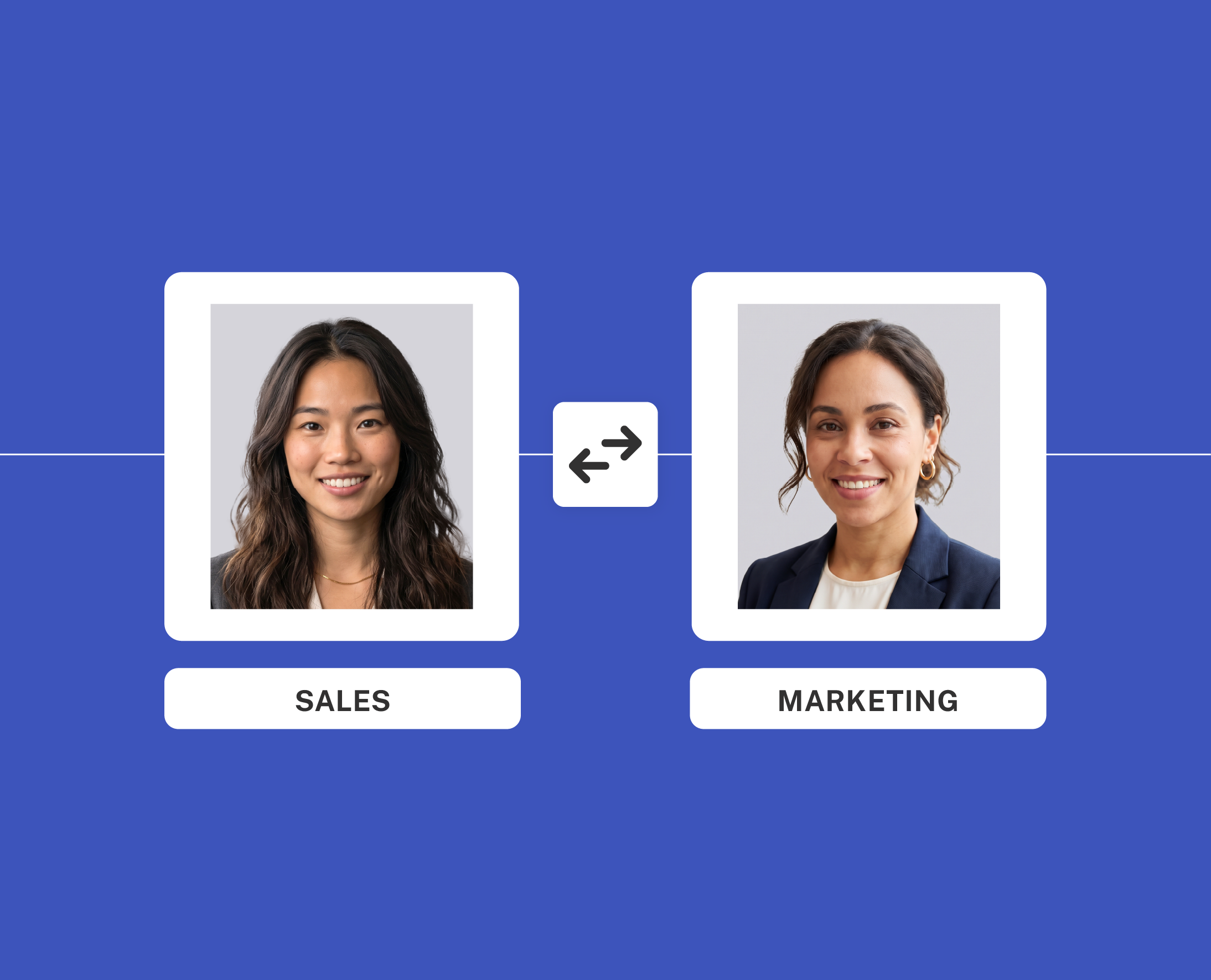
When I talk about alignment inside a CRM, I mean both teams work from the same records and the same definitions, and chase one shared pipeline number.

I've pulled in our CEO, Chris Muldoon, for the parts where opinions matter.

What does sales and marketing alignment look like inside a CRM?

In a shared CRM, alignment means both teams see the same fields on every record, use the same lifecycle stages and lead statuses, and report against one pipeline target. Marketing can see what happened on the phone. Sales can see what happened on the website. Nobody keeps a private spreadsheet.

HubSpot's State of Sales research found 91% of sellers say their sales and marketing teams are aligned, but only 41% say strongly. The friction comes from communication gaps (41%) and from the teams using different tools (39%).

Each record should hold the buyer's history, making the CRM a goldmine of buying context for both teams.

What should both teams see on every contact and account record?

Start with a short list. You can always add fields. You can almost never get people to stop ignoring them.

  • Lifecycle stage (marketing until the lead is sales qualified, then sales). One source of truth on where the buyer is.
  • Lead status (sales). Shows what happened after the handoff.
  • Lead score, split into fit and engagement (marketing). Tells SDRs who to call first.
  • Original and latest source (system). Shows which channels to fund.
  • Recent website visits and pages viewed (system). A pricing page visit on Tuesday is a reason to call on Wednesday.
  • Events registered and attended (marketing). Gives SDRs a real opener.
  • Content downloaded (marketing). Shows which problem they're reading about.
  • Current provider and renewal date (SDR). Turns a "not now" into a date in the diary.
  • Other decision makers (SDR). Lets you reach several people in the buying group.
  • Consent basis for UK and EMEA contacts (marketing ops). Keeps nurture legal under UK GDPR and PECR.

Which lifecycle stages and lead statuses do you need?

In HubSpot, lifecycle stages run from Subscriber through Lead, MQL, SQL (sales qualified lead), Opportunity and Customer. Lead status sits alongside, with values like New, Attempted to Contact, Connected and Bad Timing.

The trap is treating the two as the same thing. Lifecycle stage answers where is this buyer in the journey? Lead status answers what has sales done about it? When those blur, each team ends up telling a different story from the same data.

Set these rules on day one:

  1. Write a one-line definition for every stage and pin it in the CRM, not in a slide deck nobody opens.
  2. Lifecycle stage moves forward automatically. Only RevOps can move it backwards.
  3. Every lead status of Unqualified needs a reason picked from a dropdown. "Bad lead" is not a reason. (It's a mood.)

Should marketing be measured on pipeline instead of MQLs?

Yes. When marketing is measured on MQLs and sales on SQLs, each team hits its own number and blames the other for the gap between them.

"The best teams I know have a shared revenue goal and shared target, which they're both working towards." Chris Muldoon, CEO, Punch!

Goodhart's Law says that when a measure becomes a target, it stops being a good measure. MQLs are the textbook case. Tie a team's bonus to MQLs and you'll get lots of them, some from students and some from competitors.

Gartner's June 2024 survey found teams with shared insight into the buyer journey are 2.3 times more likely to report higher conversion rates. Yet 60% of the teams surveyed lacked that shared insight.

Published MQL to SQL conversion rates range from about 13% to 40%, mostly because every company defines an MQL differently. We dig into what moves that number in our MQL to SQL conversion guide.

How to set a joint pipeline target in your CRM

First, two terms. Sourced pipeline is pipeline where marketing created the first touch, such as a form fill or an event scan. Influenced pipeline is pipeline where marketing touched the account at any point before or during the deal, even if an SDR booked the meeting.

  • Build one dashboard both leaders own, showing pipeline created, pipeline progressed and closed revenue by month.
  • Show sourced and influenced pipeline side by side, so marketing gets credit for warming up accounts that sales later booked.
  • Keep MQL volume, MQL to SQL rate and speed to first touch on a second tab. They're diagnostic. Nobody gets fired over them.
  • Review it together, in the same meeting, every month. Separate meetings breed separate stories.

The same shared number underpins an outbound motion that scales.

Who should own lead scoring, sales or marketing?

Marketing, with sales feeding back on what the scores turn into.

"Lead scoring should be owned by marketing: tracking website visitors, engagement, downloads. This is a marketing activity. The data should be used by sales but scoring should be done by marketing." Chris Muldoon

You'll find plenty of advice saying both teams should own it. ZoomInfo's guidance, for example, leans towards sales and marketing agreeing the thresholds jointly.

In practice, joint ownership of a scoring model usually means nobody updates it. It sits in HubSpot for 18 months, scoring people on a webinar you stopped running in 2024. I'd rather have one owner and a feedback loop that works.

How to build the feedback loop into your CRM

  • Split the score into fit (company size, industry, role) and engagement (visits, downloads, events). HubSpot lets you build both as separate score properties. A perfect-fit account with zero engagement needs a different call from a student who's read everything.
  • Add a required dropdown when an SDR disqualifies a high-scoring lead, with options like "wrong role", "too small", "student or researcher", "competitor" and "existing customer".
  • Marketing reviews those reasons monthly and adjusts the weights.
  • Once a quarter, pull every deal you won in the last 12 months and check what the score was when the SDR first called. If your best customers scored 30 out of 100, your model is scoring the wrong things.

What does a good lead handoff process look like?

A good lead handoff process moves the lead and its context to sales at the same time, inside an agreed response window. Marketing commits to the fields being filled. Sales commits to a fast first touch, and to rejecting leads with a reason rather than ignoring them. Both commitments live in a written SLA (service level agreement).

At the 2008 Beijing Olympics, both US 4x100m relay teams, men and women, dropped the baton in the heats. Some of the fastest sprinters on the planet went out at the changeover.

Your handoff is the baton, and it doesn't matter how fast either runner is if it ends up on the track.

Influ2, an account-based advertising company, found in its 2025 research that only 11% of companies have both aligned audiences and an effective handoff. More than half (53%) have handoff misalignment. If yours feels clunky, you're in the majority.

What information should travel with the lead?

When an SDR opens a new lead, they should see this without clicking around:

  • Why it was handed over, in plain words. "Visited pricing twice and attended the October webinar" beats "Score: 72".
  • Every marketing touch in the last 90 days.
  • Fit data, such as company size, industry, tech stack and role.
  • Anything already known about the buying group.
  • Consent status, so nobody calls or emails someone they shouldn't.

If an SDR has to open four tabs to work out why a lead exists, they'll skip it and call someone on their own list. I would too.

How fast should sales respond?

Within the hour, ideally, for anyone who asks for a demo.

Harvard Business Review's "The Short Life of Online Sales Leads" (2011) found the average company took 42 hours to respond to a web lead, and 23% never responded at all.

Our own numbers are fresher. When we worked with Lumi, following up inbound leads within the first hour lifted conversion seven times over. We break that down in our guide to turning MQLs into SQLs, and it shapes how we run B2B appointment setting.

Put the response window in the SLA. Then build a CRM report that shows, per SDR, the time from handoff to first touch, and look at it every Monday. That number drops fast once people know someone's looking.

How should SDRs use marketing data in the CRM?

As their first source of buying signals. Website visits, downloads, email engagement and event attendance all tell an SDR who to call and what to open with. This is first-party data: information you collect on your own channels, so nobody else has it.

I asked Chris what SDRs should be asking marketing for.

"Personally, everything."

"A good SDR should take all this data that marketing provides and run with it." Chris Muldoon, CEO, Punch!

Too often an SDR is treated as someone who receives a lead. A ticket lands, they call it, job done. That wastes a smart person with a phone.

The best SDRs treat the CRM like a detective's evidence board. Before they pick up the phone, they check:

  • who from the account has been on the website, and which pages they read
  • which events they registered for or attended
  • whether several people from one account are reading the same case study this week
  • whether anyone came to a past event and never got a follow-up

That's signal-based selling in its simplest form, starting with signals you already own.

The SDR views every CRM should have

Build these as saved views or lists, owned by the SDR team:

  1. Hot accounts this week. ICP (ideal customer profile) fit, plus two or more people from the account on the website in the last seven days.
  2. Pricing and comparison page visitors. Anyone who's looked at pricing, comparison pages or case studies in the last 14 days, with no open deal.
  3. Event no-shows. Registered, didn't attend. They were interested enough to sign up, so call them.
  4. Gone quiet. Lost deals or Bad Timing contacts who've started engaging with content again.
  5. New faces at old accounts. New contacts at accounts you've spoken to before, often someone new with a budget and a point to prove.

Compare an opener like "I saw a few of your team reading how we cut onboarding time for a logistics firm. Is that on your list this quarter?" with "Just checking in."

Adding external signals on top

Your CRM only sees what happens on your own channels. Plenty of buying moments happen elsewhere. A new CFO (chief financial officer) starts, or a job ad spells out the exact problem you solve.

We use HotSauce, Punch!'s Unique-to-You (U2U) Signal Intelligence platform, to find buying signals built for each client's market and push them into the CRM next to the marketing data. An SDR then sees the website visit and the reason behind it in one place.

How should SDRs support events before and after?

At both ends, with every outcome logged against the event in the CRM.

"All the great work marketing does (inbounds, content, events, webinars, etc.) should all be integrated and followed up with a good outbound strategy. I.e. if you're doing an event, pre- and post-event the SDRs should be picking up those leads to drive attendance and follow up with delegates." Chris Muldoon,

Events go wrong in the gap between the badge scanner and the CRM. Scans sit in a spreadsheet for a fortnight, and by the time anyone calls, delegates can't remember which stand you were. The fix is to set the event up as a CRM campaign that SDRs can work from day one.

A simple SDR event workflow

  1. Six weeks out. Marketing creates the event as a campaign in the CRM. SDRs get a target account list for it.
  2. Two to four weeks out. SDRs call and email target accounts with a personal invite. Registrations are tagged to the campaign automatically.
  3. Two days out. SDRs call registered contacts at priority accounts to confirm. A call does more for attendance than another reminder email.
  4. On the day. Badge scans go straight into the CRM through the event app or an integration. No spreadsheets.
  5. Within 48 hours. SDRs follow up every attendee at an ICP account, mentioning the session they attended or the conversation they had.
  6. Week two. No-shows get a recording or summary, plus a call.
  7. Week four. Marketing reports sourced and influenced pipeline from the event, straight from the campaign.

We've used this approach to turn a one-off event into months of pipeline. Our Hut 3 case study shows what that looks like in practice. For SDRs reacting to events in your buyers' world as well as your own, have a look at trigger events for B2B sales.

What should you do with inbound leads that aren't ready to talk?

Follow up every one, and treat a qualified conversation as a good outcome even without a meeting.

"That's fine. This is more likely than not going to happen." Chris Muldoon, CEO, Punch!

Someone downloads your guide on a Sunday night because their boss mentioned the topic on Friday. They're curious, and months away from buying. The SDR calls once, hears "not right now", sets the status to Bad Timing and moves on. The contact drops into a generic newsletter, and eight months later they buy from a competitor who stayed in touch.

Count qualified conversations alongside booked meetings

The root cause is usually the SDR's KPIs (key performance indicators).

"So many SDRs are KPI'd on meetings booked and meetings sat. They forget that a good strong conversation with a qualified prospect is just as important." Chris Muldoon

If meetings are the only number on an SDR's dashboard, a "not now" feels like a failure. So they rush the call and skip the questions that matter.

Track qualified conversations with captured intel as a second metric, next to meetings booked and sat. Make these fields required when an SDR logs a qualified "not now":

  • Current provider
  • Contract renewal or budget date
  • Other people involved in the decision
"Even if they're not ready to buy just yet, understanding who they're using, when budgets get renewed, and who else is involved in the decision-making process is really, really valuable. This is how SDRs build a really strong pipeline." Chris Muldoon

How sales and marketing nurture jointly

A renewal date in the CRM becomes a workflow. Marketing sends content that matches the problem the prospect described on the call. The SDR gets a task 90 days before renewal to reconnect. If the account starts engaging again before then, the "Gone quiet" view flags it.

At Punch! we run this through our Relationship Revenue framework. It keeps high-fit accounts warm with structured, signal-triggered contact across the buying group until their timing shifts. It's a core part of our Human SDR managed services.

Without it, prospects drift away, and if some of those "not nows" have already gone cold, start with the lost deal recovery playbook.

Is attribution worth it if sales and marketing share one CRM?

Yes, for budget decisions. For judging teams, use the shared pipeline target instead.

"If someone came to an event a year ago, then downloaded some content a few months after, and then an SDR picked up the phone 6 months after and put them in, most CRMs would pinpoint this at a single point in time. The BDR is credited for the lead but the reality is that attending an event a year ago was the reason they knew the brand."

(BDR means business development representative. Same seat as an SDR, different badge, depending on who you ask.)

The event, the content and the SDR call all played a part, and a shared target means nobody has to fight over which one counts.

The tools haven't solved this either. In 2024, 6sense, an account-based marketing platform, found 57% of marketers use both sourced and influenced attribution. RevSure, a pipeline analytics company, found in 2025 that only 18.2% use integrated attribution across channels. Chris Walker, who built Refine Labs, has spent years arguing that software attribution misses "dark social", like a podcast episode or a LinkedIn post someone read on the train. None of that shows up in your CRM.

A practical attribution setup

  • Keep the system's original source and latest source fields, and don't edit them by hand.
  • Add a required "How did you hear about us?" free-text field on demo forms, and ask it again on the discovery call. The answer is often a podcast or a former colleague.
  • Report sourced and influenced pipeline side by side. The campaign influence reports in HubSpot and Salesforce, which show every campaign that touched a deal, will get you most of the way.
  • Review channel mix quarterly to move budget. Keep it out of performance reviews.

How does sales feedback make marketing content better?

SDRs hear what buyers object to and struggle with every day. Logged in the CRM and reviewed with marketing, that feedback decides the next webinar, one-pager or campaign.

Chris wants marketers asking SDRs for:

  • the objections they hear
  • why prospects say they aren't interested
  • the pain points buyers raise
  • what the buyer's working day looks like

That feeds straight into decisions like the topic of the next webinar or the one-pager sales needs most.

Say your SDRs tag objections in the CRM with a simple dropdown, and "we already buy intent data" comes up dozens of times in a month. Handling it that often on the phone wears an SDR down fast. A short explainer on the gap between shared intent feeds and signals built for one business lets SDRs answer it before it comes up.

How to build the loop

  • Add an objection dropdown and a short free-text "what they said" field to every call outcome.
  • Use call recording and analysis tools like Gong and Orum to pull themes at scale. Search transcripts for competitor names, pricing pushback and the phrases buyers use for their own problems.
  • Hold a 30-minute monthly review with the SDR manager, content lead and product marketer. Agree the top five objections and top five pain points, then make one content decision.
  • Get every marketer on at least two live SDR calls a quarter.
"No longer needs a manual process but that said, I would always encourage a marketing team to join some discovery calls and SDR calls to help really understand how the proposition is landing." Chris Muldoon, CEO,

Hearing a VP of Operations sigh down the phone teaches you more than any dashboard. 

How do you keep CRM data clean enough to trust?

Give every important field one owner, enrich records on a schedule, and make the fields that matter required at the moment they're filled in. Enrichment means topping up records with fresh data, such as a new job title or company size, from an outside data provider. If either team stops trusting the CRM, alignment falls apart.

Every workflow in this post depends on the data being right.

Validity, a CRM data quality company, found in its State of CRM Data Management 2025 report that 76% of organisations say less than half their CRM data is accurate and complete. Over a third (37%) said they'd lost revenue because of poor data.

It also gets worse on its own. Research going back to MarketingSherpa puts B2B data decay at roughly a fifth to a quarter of a database every year, as people move to new roles and new companies. In 2021, Gartner put the average cost of poor data quality at $12.9 million a year.

Who owns which fields?

Start with the owners in the field list earlier in this post, then add these rules.

  1. If a field has no owner, delete it or give it one. Orphan fields are where bad data breeds.
  2. Run enrichment monthly on active accounts and quarterly on the rest.
  3. Make the SDR-owned fields (current provider, renewal date, decision makers) required when a call outcome is logged.

UK GDPR and PECR consent fields for UK and EMEA

If you sell into the UK or EMEA (Europe, the Middle East and Africa), your nurture rules differ from the US. UK GDPR (General Data Protection Regulation) and PECR (Privacy and Electronic Communications Regulations) shape what you can send and to whom.

In practice, that means a few extra fields:

  • Lawful basis for processing (legitimate interest or consent)
  • Email marketing consent status and date
  • Country, so workflows route UK and EU contacts down the right path
  • Opt-out date and channel

This isn't legal advice, and your legal team should sign off on the setup. But if your CRM can't tell a Manchester contact from a Miami one, your joint nurture is a risk. 

Sales and marketing CRM alignment checklist

Work through this in your next joint sales and marketing meeting.

  • One pipeline and revenue target, shared by both teams, on one dashboard
  • A written one-line definition for every lifecycle stage, pinned in the CRM
  • Lifecycle stage and lead status kept separate, with clear owners
  • Marketing owns the lead scoring model, split into fit and engagement
  • Required disqualification reasons on high-scoring leads, reviewed monthly
  • A written SLA covering handoff fields, response time and rejection reasons
  • A weekly report on time from handoff to first touch, per SDR
  • SDR saved views for hot accounts, pricing page visitors, event no-shows and re-engaged contacts
  • External buying signals pushed into the CRM next to marketing data
  • Every event set up as a CRM campaign, with SDR tasks before and after
  • Qualified conversations tracked next to meetings booked and sat
  • Current provider, renewal date and decision makers required on "not now" outcomes
  • Sourced and influenced pipeline reported side by side
  • "How did you hear about us?" captured on forms and on discovery calls
  • Objection tags on call outcomes, reviewed with marketing monthly
  • Every marketer on at least two live SDR calls a quarter
  • Every important field has a named owner
  • Enrichment on a schedule
  • UK GDPR and PECR consent fields for UK and EMEA contacts
  • Handoff performance reviewed monthly, definitions reviewed quarterly

Turn your shared CRM into predictable pipeline

Go back to that quarterly review, where marketing shows growth and sales complains about quality from the same CRM. Fixing it starts with both teams agreeing what each field means and who owns it. From there, they need one pipeline number to chase together.

That's the work we do every day. HotSauce finds the buying signals unique to your market and puts them in your CRM next to your marketing data. Agentic GTM, our managed AI outreach system, acts on those signals across email, LinkedIn, one-to-one microsites, handwritten postcards and person-level ads. Our Human SDR managed services turn those signals, and every marketing touch you already have, into real conversations and pipeline.

See how Agentic GTM and Human SDRs work together.

Sales and marketing alignment in a CRM (customer relationship management system) sounds like a RevOps (revenue operations) ticket. Map some fields. Sync some stages. Done by Friday.

It never is.

In 2025, Mutiny, a website personalisation company, surveyed sales and marketing leaders for a report covered by MarketingProfs. Two-thirds said they'd thought about replacing their counterpart. Only 24% said the two teams were completely aligned.

Gartner's B2B Commercial Strategy Survey, from June 2024, found marketing and sales collaborate on just 3 of 15 core commercial activities.

You can see the gap in almost any quarterly review. Marketing shows MQL (marketing qualified lead) growth. Sales says lead quality is poor. Both pull their numbers from the same CRM.

When I talk about alignment inside a CRM, I mean both teams work from the same records and the same definitions, and chase one shared pipeline number.

I've pulled in our CEO, Chris Muldoon, for the parts where opinions matter.

What does sales and marketing alignment look like inside a CRM?

In a shared CRM, alignment means both teams see the same fields on every record, use the same lifecycle stages and lead statuses, and report against one pipeline target. Marketing can see what happened on the phone. Sales can see what happened on the website. Nobody keeps a private spreadsheet.

HubSpot's State of Sales research found 91% of sellers say their sales and marketing teams are aligned, but only 41% say strongly. The friction comes from communication gaps (41%) and from the teams using different tools (39%).

Each record should hold the buyer's history, making the CRM a goldmine of buying context for both teams.

What should both teams see on every contact and account record?

Start with a short list. You can always add fields. You can almost never get people to stop ignoring them.

  • Lifecycle stage (marketing until the lead is sales qualified, then sales). One source of truth on where the buyer is.
  • Lead status (sales). Shows what happened after the handoff.
  • Lead score, split into fit and engagement (marketing). Tells SDRs who to call first.
  • Original and latest source (system). Shows which channels to fund.
  • Recent website visits and pages viewed (system). A pricing page visit on Tuesday is a reason to call on Wednesday.
  • Events registered and attended (marketing). Gives SDRs a real opener.
  • Content downloaded (marketing). Shows which problem they're reading about.
  • Current provider and renewal date (SDR). Turns a "not now" into a date in the diary.
  • Other decision makers (SDR). Lets you reach several people in the buying group.
  • Consent basis for UK and EMEA contacts (marketing ops). Keeps nurture legal under UK GDPR and PECR.

Which lifecycle stages and lead statuses do you need?

In HubSpot, lifecycle stages run from Subscriber through Lead, MQL, SQL (sales qualified lead), Opportunity and Customer. Lead status sits alongside, with values like New, Attempted to Contact, Connected and Bad Timing.

The trap is treating the two as the same thing. Lifecycle stage answers where is this buyer in the journey? Lead status answers what has sales done about it? When those blur, each team ends up telling a different story from the same data.

Set these rules on day one:

  1. Write a one-line definition for every stage and pin it in the CRM, not in a slide deck nobody opens.
  2. Lifecycle stage moves forward automatically. Only RevOps can move it backwards.
  3. Every lead status of Unqualified needs a reason picked from a dropdown. "Bad lead" is not a reason. (It's a mood.)

Should marketing be measured on pipeline instead of MQLs?

Yes. When marketing is measured on MQLs and sales on SQLs, each team hits its own number and blames the other for the gap between them.

"The best teams I know have a shared revenue goal and shared target, which they're both working towards." Chris Muldoon, CEO, Punch!

Goodhart's Law says that when a measure becomes a target, it stops being a good measure. MQLs are the textbook case. Tie a team's bonus to MQLs and you'll get lots of them, some from students and some from competitors.

Gartner's June 2024 survey found teams with shared insight into the buyer journey are 2.3 times more likely to report higher conversion rates. Yet 60% of the teams surveyed lacked that shared insight.

Published MQL to SQL conversion rates range from about 13% to 40%, mostly because every company defines an MQL differently. We dig into what moves that number in our MQL to SQL conversion guide.

How to set a joint pipeline target in your CRM

First, two terms. Sourced pipeline is pipeline where marketing created the first touch, such as a form fill or an event scan. Influenced pipeline is pipeline where marketing touched the account at any point before or during the deal, even if an SDR booked the meeting.

  • Build one dashboard both leaders own, showing pipeline created, pipeline progressed and closed revenue by month.
  • Show sourced and influenced pipeline side by side, so marketing gets credit for warming up accounts that sales later booked.
  • Keep MQL volume, MQL to SQL rate and speed to first touch on a second tab. They're diagnostic. Nobody gets fired over them.
  • Review it together, in the same meeting, every month. Separate meetings breed separate stories.

The same shared number underpins an outbound motion that scales.

Who should own lead scoring, sales or marketing?

Marketing, with sales feeding back on what the scores turn into.

"Lead scoring should be owned by marketing: tracking website visitors, engagement, downloads. This is a marketing activity. The data should be used by sales but scoring should be done by marketing." Chris Muldoon

You'll find plenty of advice saying both teams should own it. ZoomInfo's guidance, for example, leans towards sales and marketing agreeing the thresholds jointly.

In practice, joint ownership of a scoring model usually means nobody updates it. It sits in HubSpot for 18 months, scoring people on a webinar you stopped running in 2024. I'd rather have one owner and a feedback loop that works.

How to build the feedback loop into your CRM

  • Split the score into fit (company size, industry, role) and engagement (visits, downloads, events). HubSpot lets you build both as separate score properties. A perfect-fit account with zero engagement needs a different call from a student who's read everything.
  • Add a required dropdown when an SDR disqualifies a high-scoring lead, with options like "wrong role", "too small", "student or researcher", "competitor" and "existing customer".
  • Marketing reviews those reasons monthly and adjusts the weights.
  • Once a quarter, pull every deal you won in the last 12 months and check what the score was when the SDR first called. If your best customers scored 30 out of 100, your model is scoring the wrong things.

What does a good lead handoff process look like?

A good lead handoff process moves the lead and its context to sales at the same time, inside an agreed response window. Marketing commits to the fields being filled. Sales commits to a fast first touch, and to rejecting leads with a reason rather than ignoring them. Both commitments live in a written SLA (service level agreement).

At the 2008 Beijing Olympics, both US 4x100m relay teams, men and women, dropped the baton in the heats. Some of the fastest sprinters on the planet went out at the changeover.

Your handoff is the baton, and it doesn't matter how fast either runner is if it ends up on the track.

Influ2, an account-based advertising company, found in its 2025 research that only 11% of companies have both aligned audiences and an effective handoff. More than half (53%) have handoff misalignment. If yours feels clunky, you're in the majority.

What information should travel with the lead?

When an SDR opens a new lead, they should see this without clicking around:

  • Why it was handed over, in plain words. "Visited pricing twice and attended the October webinar" beats "Score: 72".
  • Every marketing touch in the last 90 days.
  • Fit data, such as company size, industry, tech stack and role.
  • Anything already known about the buying group.
  • Consent status, so nobody calls or emails someone they shouldn't.

If an SDR has to open four tabs to work out why a lead exists, they'll skip it and call someone on their own list. I would too.

How fast should sales respond?

Within the hour, ideally, for anyone who asks for a demo.

Harvard Business Review's "The Short Life of Online Sales Leads" (2011) found the average company took 42 hours to respond to a web lead, and 23% never responded at all.

Our own numbers are fresher. When we worked with Lumi, following up inbound leads within the first hour lifted conversion seven times over. We break that down in our guide to turning MQLs into SQLs, and it shapes how we run B2B appointment setting.

Put the response window in the SLA. Then build a CRM report that shows, per SDR, the time from handoff to first touch, and look at it every Monday. That number drops fast once people know someone's looking.

How should SDRs use marketing data in the CRM?

As their first source of buying signals. Website visits, downloads, email engagement and event attendance all tell an SDR who to call and what to open with. This is first-party data: information you collect on your own channels, so nobody else has it.

I asked Chris what SDRs should be asking marketing for.

"Personally, everything."

"A good SDR should take all this data that marketing provides and run with it." Chris Muldoon, CEO, Punch!

Too often an SDR is treated as someone who receives a lead. A ticket lands, they call it, job done. That wastes a smart person with a phone.

The best SDRs treat the CRM like a detective's evidence board. Before they pick up the phone, they check:

  • who from the account has been on the website, and which pages they read
  • which events they registered for or attended
  • whether several people from one account are reading the same case study this week
  • whether anyone came to a past event and never got a follow-up

That's signal-based selling in its simplest form, starting with signals you already own.

The SDR views every CRM should have

Build these as saved views or lists, owned by the SDR team:

  1. Hot accounts this week. ICP (ideal customer profile) fit, plus two or more people from the account on the website in the last seven days.
  2. Pricing and comparison page visitors. Anyone who's looked at pricing, comparison pages or case studies in the last 14 days, with no open deal.
  3. Event no-shows. Registered, didn't attend. They were interested enough to sign up, so call them.
  4. Gone quiet. Lost deals or Bad Timing contacts who've started engaging with content again.
  5. New faces at old accounts. New contacts at accounts you've spoken to before, often someone new with a budget and a point to prove.

Compare an opener like "I saw a few of your team reading how we cut onboarding time for a logistics firm. Is that on your list this quarter?" with "Just checking in."

Adding external signals on top

Your CRM only sees what happens on your own channels. Plenty of buying moments happen elsewhere. A new CFO (chief financial officer) starts, or a job ad spells out the exact problem you solve.

We use HotSauce, Punch!'s Unique-to-You (U2U) Signal Intelligence platform, to find buying signals built for each client's market and push them into the CRM next to the marketing data. An SDR then sees the website visit and the reason behind it in one place.

How should SDRs support events before and after?

At both ends, with every outcome logged against the event in the CRM.

"All the great work marketing does (inbounds, content, events, webinars, etc.) should all be integrated and followed up with a good outbound strategy. I.e. if you're doing an event, pre- and post-event the SDRs should be picking up those leads to drive attendance and follow up with delegates." Chris Muldoon,

Events go wrong in the gap between the badge scanner and the CRM. Scans sit in a spreadsheet for a fortnight, and by the time anyone calls, delegates can't remember which stand you were. The fix is to set the event up as a CRM campaign that SDRs can work from day one.

A simple SDR event workflow

  1. Six weeks out. Marketing creates the event as a campaign in the CRM. SDRs get a target account list for it.
  2. Two to four weeks out. SDRs call and email target accounts with a personal invite. Registrations are tagged to the campaign automatically.
  3. Two days out. SDRs call registered contacts at priority accounts to confirm. A call does more for attendance than another reminder email.
  4. On the day. Badge scans go straight into the CRM through the event app or an integration. No spreadsheets.
  5. Within 48 hours. SDRs follow up every attendee at an ICP account, mentioning the session they attended or the conversation they had.
  6. Week two. No-shows get a recording or summary, plus a call.
  7. Week four. Marketing reports sourced and influenced pipeline from the event, straight from the campaign.

We've used this approach to turn a one-off event into months of pipeline. Our Hut 3 case study shows what that looks like in practice. For SDRs reacting to events in your buyers' world as well as your own, have a look at trigger events for B2B sales.

What should you do with inbound leads that aren't ready to talk?

Follow up every one, and treat a qualified conversation as a good outcome even without a meeting.

"That's fine. This is more likely than not going to happen." Chris Muldoon, CEO, Punch!

Someone downloads your guide on a Sunday night because their boss mentioned the topic on Friday. They're curious, and months away from buying. The SDR calls once, hears "not right now", sets the status to Bad Timing and moves on. The contact drops into a generic newsletter, and eight months later they buy from a competitor who stayed in touch.

Count qualified conversations alongside booked meetings

The root cause is usually the SDR's KPIs (key performance indicators).

"So many SDRs are KPI'd on meetings booked and meetings sat. They forget that a good strong conversation with a qualified prospect is just as important." Chris Muldoon

If meetings are the only number on an SDR's dashboard, a "not now" feels like a failure. So they rush the call and skip the questions that matter.

Track qualified conversations with captured intel as a second metric, next to meetings booked and sat. Make these fields required when an SDR logs a qualified "not now":

  • Current provider
  • Contract renewal or budget date
  • Other people involved in the decision
"Even if they're not ready to buy just yet, understanding who they're using, when budgets get renewed, and who else is involved in the decision-making process is really, really valuable. This is how SDRs build a really strong pipeline." Chris Muldoon

How sales and marketing nurture jointly

A renewal date in the CRM becomes a workflow. Marketing sends content that matches the problem the prospect described on the call. The SDR gets a task 90 days before renewal to reconnect. If the account starts engaging again before then, the "Gone quiet" view flags it.

At Punch! we run this through our Relationship Revenue framework. It keeps high-fit accounts warm with structured, signal-triggered contact across the buying group until their timing shifts. It's a core part of our Human SDR managed services.

Without it, prospects drift away, and if some of those "not nows" have already gone cold, start with the lost deal recovery playbook.

Is attribution worth it if sales and marketing share one CRM?

Yes, for budget decisions. For judging teams, use the shared pipeline target instead.

"If someone came to an event a year ago, then downloaded some content a few months after, and then an SDR picked up the phone 6 months after and put them in, most CRMs would pinpoint this at a single point in time. The BDR is credited for the lead but the reality is that attending an event a year ago was the reason they knew the brand."

(BDR means business development representative. Same seat as an SDR, different badge, depending on who you ask.)

The event, the content and the SDR call all played a part, and a shared target means nobody has to fight over which one counts.

The tools haven't solved this either. In 2024, 6sense, an account-based marketing platform, found 57% of marketers use both sourced and influenced attribution. RevSure, a pipeline analytics company, found in 2025 that only 18.2% use integrated attribution across channels. Chris Walker, who built Refine Labs, has spent years arguing that software attribution misses "dark social", like a podcast episode or a LinkedIn post someone read on the train. None of that shows up in your CRM.

A practical attribution setup

  • Keep the system's original source and latest source fields, and don't edit them by hand.
  • Add a required "How did you hear about us?" free-text field on demo forms, and ask it again on the discovery call. The answer is often a podcast or a former colleague.
  • Report sourced and influenced pipeline side by side. The campaign influence reports in HubSpot and Salesforce, which show every campaign that touched a deal, will get you most of the way.
  • Review channel mix quarterly to move budget. Keep it out of performance reviews.

How does sales feedback make marketing content better?

SDRs hear what buyers object to and struggle with every day. Logged in the CRM and reviewed with marketing, that feedback decides the next webinar, one-pager or campaign.

Chris wants marketers asking SDRs for:

  • the objections they hear
  • why prospects say they aren't interested
  • the pain points buyers raise
  • what the buyer's working day looks like

That feeds straight into decisions like the topic of the next webinar or the one-pager sales needs most.

Say your SDRs tag objections in the CRM with a simple dropdown, and "we already buy intent data" comes up dozens of times in a month. Handling it that often on the phone wears an SDR down fast. A short explainer on the gap between shared intent feeds and signals built for one business lets SDRs answer it before it comes up.

How to build the loop

  • Add an objection dropdown and a short free-text "what they said" field to every call outcome.
  • Use call recording and analysis tools like Gong and Orum to pull themes at scale. Search transcripts for competitor names, pricing pushback and the phrases buyers use for their own problems.
  • Hold a 30-minute monthly review with the SDR manager, content lead and product marketer. Agree the top five objections and top five pain points, then make one content decision.
  • Get every marketer on at least two live SDR calls a quarter.
"No longer needs a manual process but that said, I would always encourage a marketing team to join some discovery calls and SDR calls to help really understand how the proposition is landing." Chris Muldoon, CEO,

Hearing a VP of Operations sigh down the phone teaches you more than any dashboard. 

How do you keep CRM data clean enough to trust?

Give every important field one owner, enrich records on a schedule, and make the fields that matter required at the moment they're filled in. Enrichment means topping up records with fresh data, such as a new job title or company size, from an outside data provider. If either team stops trusting the CRM, alignment falls apart.

Every workflow in this post depends on the data being right.

Validity, a CRM data quality company, found in its State of CRM Data Management 2025 report that 76% of organisations say less than half their CRM data is accurate and complete. Over a third (37%) said they'd lost revenue because of poor data.

It also gets worse on its own. Research going back to MarketingSherpa puts B2B data decay at roughly a fifth to a quarter of a database every year, as people move to new roles and new companies. In 2021, Gartner put the average cost of poor data quality at $12.9 million a year.

Who owns which fields?

Start with the owners in the field list earlier in this post, then add these rules.

  1. If a field has no owner, delete it or give it one. Orphan fields are where bad data breeds.
  2. Run enrichment monthly on active accounts and quarterly on the rest.
  3. Make the SDR-owned fields (current provider, renewal date, decision makers) required when a call outcome is logged.

UK GDPR and PECR consent fields for UK and EMEA

If you sell into the UK or EMEA (Europe, the Middle East and Africa), your nurture rules differ from the US. UK GDPR (General Data Protection Regulation) and PECR (Privacy and Electronic Communications Regulations) shape what you can send and to whom.

In practice, that means a few extra fields:

  • Lawful basis for processing (legitimate interest or consent)
  • Email marketing consent status and date
  • Country, so workflows route UK and EU contacts down the right path
  • Opt-out date and channel

This isn't legal advice, and your legal team should sign off on the setup. But if your CRM can't tell a Manchester contact from a Miami one, your joint nurture is a risk. 

Sales and marketing CRM alignment checklist

Work through this in your next joint sales and marketing meeting.

  • One pipeline and revenue target, shared by both teams, on one dashboard
  • A written one-line definition for every lifecycle stage, pinned in the CRM
  • Lifecycle stage and lead status kept separate, with clear owners
  • Marketing owns the lead scoring model, split into fit and engagement
  • Required disqualification reasons on high-scoring leads, reviewed monthly
  • A written SLA covering handoff fields, response time and rejection reasons
  • A weekly report on time from handoff to first touch, per SDR
  • SDR saved views for hot accounts, pricing page visitors, event no-shows and re-engaged contacts
  • External buying signals pushed into the CRM next to marketing data
  • Every event set up as a CRM campaign, with SDR tasks before and after
  • Qualified conversations tracked next to meetings booked and sat
  • Current provider, renewal date and decision makers required on "not now" outcomes
  • Sourced and influenced pipeline reported side by side
  • "How did you hear about us?" captured on forms and on discovery calls
  • Objection tags on call outcomes, reviewed with marketing monthly
  • Every marketer on at least two live SDR calls a quarter
  • Every important field has a named owner
  • Enrichment on a schedule
  • UK GDPR and PECR consent fields for UK and EMEA contacts
  • Handoff performance reviewed monthly, definitions reviewed quarterly

Turn your shared CRM into predictable pipeline

Go back to that quarterly review, where marketing shows growth and sales complains about quality from the same CRM. Fixing it starts with both teams agreeing what each field means and who owns it. From there, they need one pipeline number to chase together.

That's the work we do every day. HotSauce finds the buying signals unique to your market and puts them in your CRM next to your marketing data. Agentic GTM, our managed AI outreach system, acts on those signals across email, LinkedIn, one-to-one microsites, handwritten postcards and person-level ads. Our Human SDR managed services turn those signals, and every marketing touch you already have, into real conversations and pipeline.

See how Agentic GTM and Human SDRs work together.

contributors
Marita van der Merwe
Marketing Manager
Expertise
No items found.
other Articles

Continue reading

6
min read
Published
09 Oct 2026
Why the Future of GTM Is Agentic
No items found.

Why the Future of GTM Is Agentic

Last updated
09 Oct 2026
5
min read
Published
06 Oct 2026
The Sales Signal Everyone Else Is Missing
No items found.

The Sales Signal Everyone Else Is Missing

Chris Muldoon

Chief Executive Officer
Last updated
06 Oct 2026

Subscribe to Punch! newsletter

A monthly dose of Sales Intelligence, delivered straight to your inbox

Thank you! Your submission has been received!
Oops! Something went wrong while submitting the form.