
Stop Blaming the Sales Team


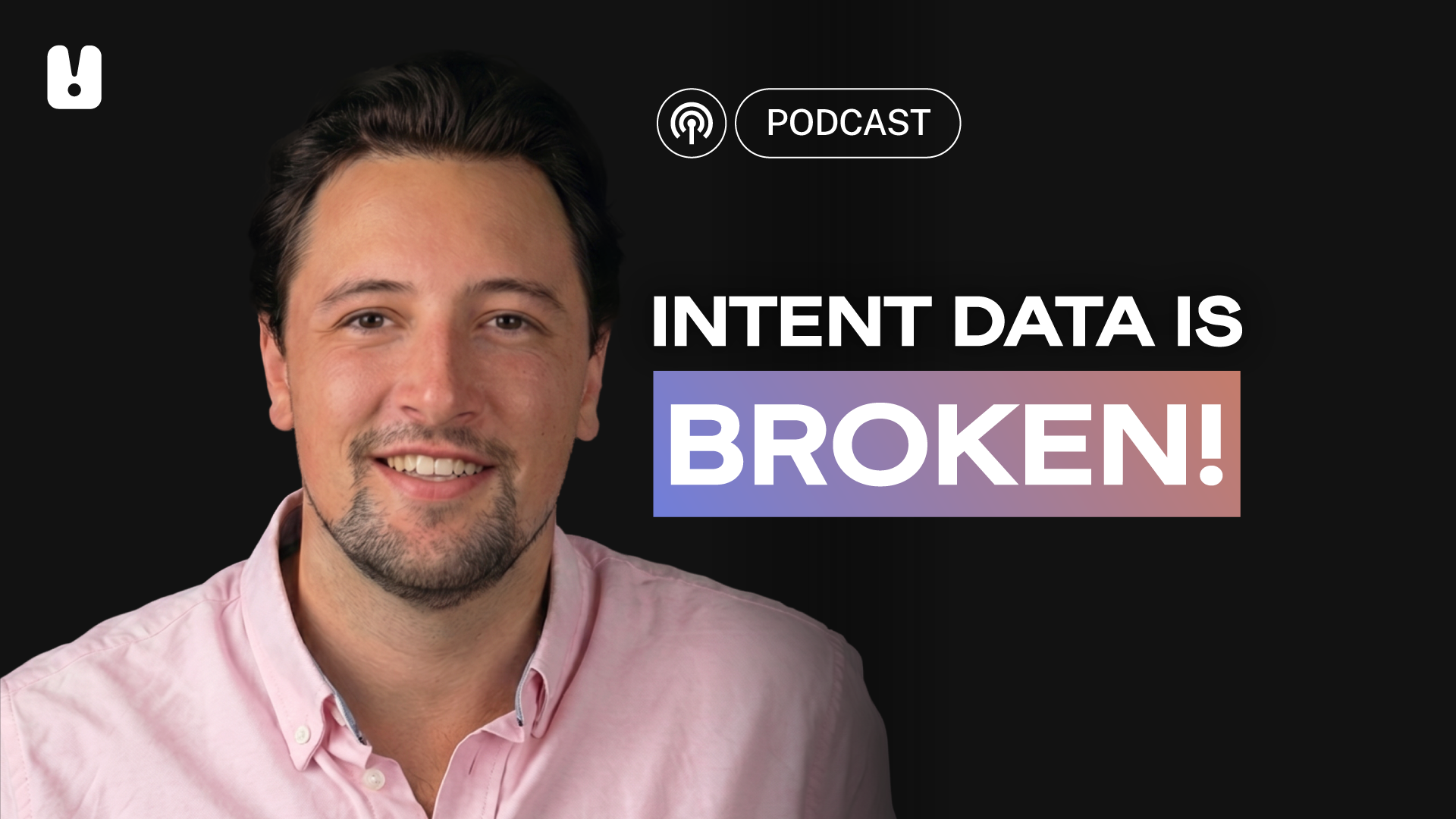
In the latest episode of B2B Outbound, Chris caught up with Russell Palmer, fractional Chief Revenue Officer and go-to-market advisor, to dig into one of the most common problems in B2B SaaS. Companies keep trying to fix sales when the real problem is hiding somewhere else entirely.
Russell has spent the last decade working with scale-up companies, typically those above $5M in annual recurring revenue, after an earlier career at IBM and Microsoft. He gets called in when revenue is falling short, growth is stalling, and founders are starting to panic. What he finds almost every time? The problem isn't what people think it is.
Russell cited some sobering numbers. Fewer than 1 in 3 revenue leaders trust their own forecast data. B2B win rates have dropped to around 21%. Nearly 60% of sellers missed quota last year. And almost every company's response has been the same: more tools, more headcount, more activity.
It hasn't worked.
Your Revenue Problem Starts Before Sales Even Begins
"I need to fix sales" is what the CEO says. What that actually means is revenue isn't booking fast enough, growth isn't sustainable, and account executives are getting ghosted halfway through the cycle.
Russell told us he sees the same symptoms in every engagement. Longer sales cycles, price pressure in negotiation, pipeline that looks busy but goes nowhere.
He starts by listening to calls, checking talk-time ratios, and watching how reps handle objections. But that stuff is rarely where the root cause lives.
"When I dig into it, I come to the conclusion that the problem is really upstream from the sales process." - Russel Palmer.
Upstream means the value proposition, the messaging, and whether the company is actually talking about the customer's real problem. Not the surface-level technical inconvenience, but the actual business problem underneath it.
Most companies aren't.
Why B2B Companies Drift From Problem-Selling to Feature-Selling
Russell described a pattern that plays out in nearly every early-stage SaaS company.
The founders start the business because they lived a painful problem. They know it inside out. Early sales conversations are deep, problem-centric, and full of empathy. Customers resonate immediately.
Then the product ships. Suddenly there's something tangible to talk about: features, demos, bells and whistles. The language of the company shifts from "here's the problem we're solving" to "here's what our thing does."
Then they hire account executives. Those reps hear product language all day, and it becomes their mother tongue. The customer-problem framing that made those early deals sing gets buried.
"Once the minimum viable product ships, conversations shift to product. They shift to bells and whistles, features and benefits. And when you start to hire salespeople, they pick up on the product stuff because that's what they hear around them every day. That becomes the natural language of the company."
By the time you notice it, you're three headcount changes deep and wondering why the pipeline looks like a ghost town.
The Talk-Time Data That Should Worry Every B2B Sales Leader
The ratio of talk time between a salesperson and a prospect is one of the strongest predictors of deal outcomes. Under 50% talking for the rep is the baseline for good outcomes.
Russell referenced research across roughly 400 account executives where the top 5-10% of performers were only speaking 30 to 40% of the time in meetings.
Most reps are doing the opposite. They fill silence with features. They answer objections with product details. A prospect saying "yeah, that's a pain" gets treated as sufficient signal to move on. It isn't. Go two layers deeper and that's where you find out whether your solution actually fits.
"It's not good enough to have a fantastic product and show the product in a great demo because everybody can do that, anybody can do that. What you really have to do is articulate: this is how this solves your problem." - Russel Palmer
If your team is still skimming the surface on discovery, our SCALE Framework blog walks through how to structure those deeper conversations.
Why More B2B Pipeline Is Not the Answer
I asked Russell in our rapid-fire closing questions: more pipeline or better quality pipeline?
"Oh yeah, much better quality pipeline. All the time." - Russel Palmer
The spray-and-pray era is well and truly over, and most companies are still measuring the wrong things and wondering why the pipeline is broken.
The game now is precision: real signals over volume. We've had clients running 5,000 emails a month with a previous agency, then seen better results from 1,200 highly-targeted, signal-led outreaches once they moved to us. Fewer emails, more pipeline.
But precision only works if the message is right, which brings us back to the value proposition.
Why AI Is Making Average B2B Sellers Worse
AI is making it worse.
Everyone is using AI, including your prospects. Russell told us about companies receiving RFPs with 503 questions in them because the buyer just asked ChatGPT "what should I ask when evaluating this type of solution?" Then the seller used ChatGPT to answer all 503.
Nobody actually talked to anybody.
Most salespeople are using AI to do the thing they should be doing themselves: thinking deeply about the customer problem and crafting a response that proves they understand it. Instead, they're producing what Russell calls "AI slop." Prospects spot it in about three seconds and bin it.
"To really get to use AI properly, as a real force multiplier rather than just the generic AI slop that people talk about, you really have to know what good looks like in the first place." - Russell Palmer
Everyone's pulling from the same data, working off the same six signals (funding rounds, headcount changes, acquisitions) and sending the same "personalised" outreach that reads identically because everyone's prompting the same model.
Real differentiation right now comes from unique, context-heavy signals combined with human judgment, plus sales development reps who actually pick up the phone. Our phone teams are the busiest they've ever been, because everyone else went all-in on email automation and burned the channel.
We built our GTM Modernisation service (our framework for blending AI tooling with human-led outbound) around this exact inflection point. AI and humans working together, not AI replacing humans.
Why No Sales Framework Will Fix a Broken Message
Russell has been in enough scale-ups to know what the playbook looks like from the outside. New framework, new methodology, new VP of Sales with their favourite system, and the same broken results.
"There isn't a silver bullet. There are lots of things that have to be in place or moving in the right direction."- Russell Palmer
What he does believe in is three things working together.
First, a clear sales process with exit criteria at every stage, so nobody is guessing where a deal actually sits.
Second, a qualification framework applied consistently. He rates SPICED (a qualification framework developed by the consultancy Winning by Design), though he'll take anything used with discipline over nothing at all.
Third, and this is the one that actually separates good teams from average ones: a problem-centric sales methodology. The skill of going deep, resisting the pull toward features, and earning the right to present a solution instead of just lobbing a deck at someone.
Then wrap that in training where reps role-play real objections, coaching where managers review actual call recordings weekly, and managers who've carried a bag themselves. That's the system.
When we pushed him on what actually separates the best sellers from everyone else, he said it plainly: "Sales excellence is not a volume problem. It is being specific to the customer." And the one question he wants every salesperson to retire immediately?
"What keeps you up at night? Whoever came up with that, it's blighted us for decades."
How to Test New Sales Messaging Without Betting the Quarter
Russell made a point about Human SDR teams that most people miss.
When a company has refined a value proposition and needs to test new messaging, the fastest and lowest-risk approach is to give it to a Human SDR team first.
Why? Because:
- They ramp fast. No six-month onboarding cycles.
- They're not already infected by the old way of selling.
- They bring methodology and structure that lets the message get a fair test.
- You get real market feedback in weeks, not quarters.
We've done this exact thing with clients. Run a focused campaign to test a new proposition before rolling it out to the entire internal team. It saves companies from embedding the wrong message at scale, which is an expensive mistake to unwind.
If you're weighing whether a Human SDR team makes sense for your business, we wrote a whole piece on exactly that.
The key condition? You need a working proposition to hand them. If you don't have that yet, Russell is right. Get the diagnosis done first.
And if you're a founder still in the early stages? Russell is clear on this too. Close the first 10-20 customers yourself. The things you learn about customers, competitors, the market and the commercial model in those conversations are irreplaceable. Bringing in a salesperson before you have a proven proposition is setting them up to fail.
So Where Do You Actually Start?
I asked Russell the closing question: a SaaS scale-up comes to you, revenue's broken, what's the first thing you do?
Diagnosis. He has a methodology that looks across eight domains of go-to-market structure, hunting for root causes, rather than symptoms. And almost always, the trail leads back to the value proposition. What problem are we actually solving, for whom, and does our messaging reflect that?
If those things are absent or wrong, no amount of sales execution improvement moves the needle. You're optimising a broken signal.
Start upstream. Everything else is downstream of that.
The B2B Revenue Gut-Check
If your sales are struggling in 2026, a new CRM won't fix it. Neither will another SDR hire. Not before you've diagnosed what's actually broken.
Ask yourself honestly:
- Are our salespeople talking about customer problems or product features?
- Do we know the real business problem our best customers were trying to solve when they bought from us?
- Is our outbound messaging rooted in that problem, or in what our thing does?
- Are we using AI to amplify good thinking or replace it?
Most companies answer those questions and find the problem isn't in the sales team. It's in the brief they were handed.
Fix that first. Then let's talk about scale
Want the Full Conversation?
Listen to the full episode of B2B Outbound now:
And if you'd like to connect with Russell directly, find him on LinkedIn


Continue reading


Subscribe to Punch! newsletter
A monthly dose of Sales Intelligence, delivered straight to your inbox